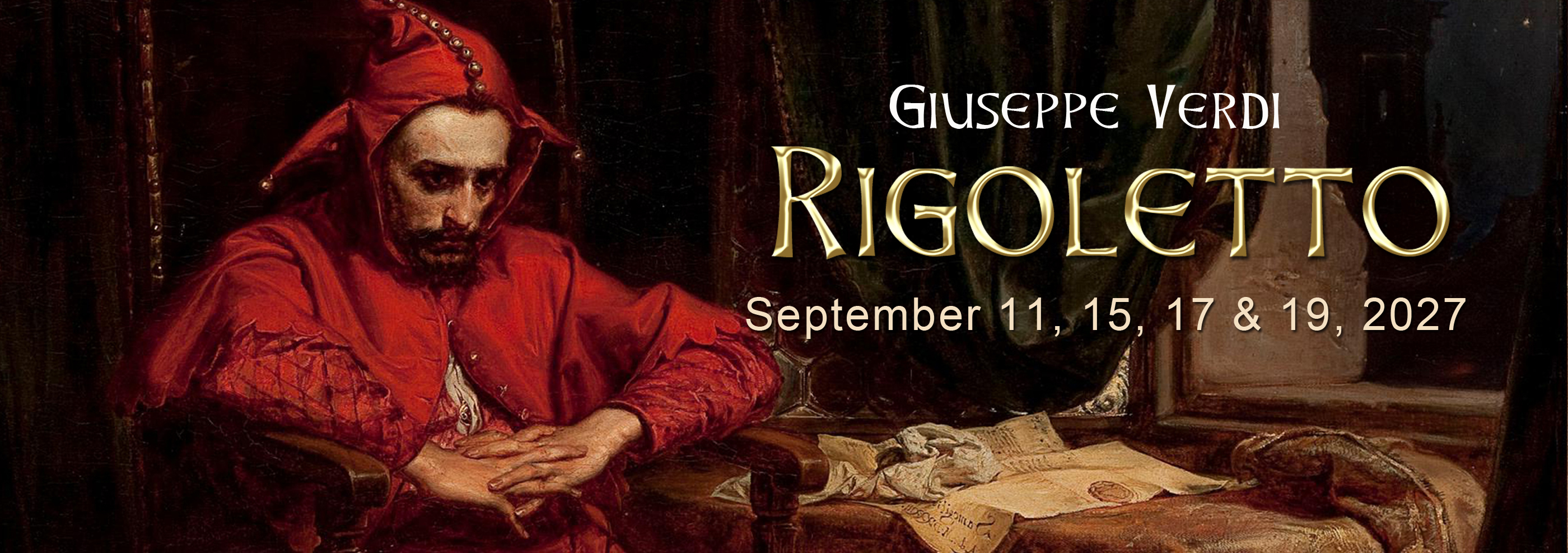
Composer: Giuseppe Verdi
Libretto: Italian libretto by Francesco Maria Piave
Premiere: March 11, 1851 at La Fenice, Venice, Italy
Duration: 2 hours, 30 minutes, with two intermissions
Performances: September 11, 15, 17 at 7pm & September 19 at 3pm
| Role | Cast A (Sept. 11 & 15) | Cast B (Sept. 17 & 19) |
|---|---|---|
| Rigoletto, the Duke's jester Baritone |
To be decided
|
To be decided
|
| Gilda, his daughter Soprano |
To be decided
|
To be decided
|
| Duke of Mantua Tenor |
To be decided
|
To be decided
|
| Sparafucile, a murderer for hire Bass |
To be decided
|
To be decided
|
| Maddalena, his sister Mezzo-Soprano |
To be decided
|
To be decided
|
| Giovanna, Gilda's Nurse Mezzo-Soprano |
To be decided
|
To be decided
|
| Count Ceprano Bass |
To be decided
|
To be decided
|
| Countess Ceprano, his wife Soprano |
To be decided
|
To be decided
|
| Matteo Borsa, a courtier Tenor |
To be decided
|
To be decided
|
| Count Monterone Baritone |
To be decided
|
To be decided
|
| Marullo Baritone |
To be decided
|
To be decided
|
Premiered: 1851
Composer: Giuseppe Verdi
Librettist: Francesco Maria Piave
Rigoletto is one of Giuseppe Verdi's most beloved and enduring masterpieces. Premiering in 1851, the opera was based on Victor Hugo's controversial play Le roi s'amuse ("The King Amuses Himself"). With its unforgettable melodies and emotionally charged drama, Verdi created a powerful story of love, revenge, innocence, and the devastating consequences of hatred and deception.
Bold and revolutionary for its time, Rigoletto challenged audiences by placing at its center not a noble hero, but a bitter, sarcastic court jester whose deepest vulnerability is his love for his daughter. The opera remains one of the most compelling explorations of parental devotion and tragic fate ever set to music.
The opera follows Rigoletto, the hunchbacked jester in the court of the Duke of Mantua. Though he mocks the Duke's victims and delights in others' misfortunes, Rigoletto fiercely protects his beloved daughter, Gilda, keeping her hidden away from the corruption of court life.
When the charming but reckless Duke secretly seduces Gilda, a series of misunderstandings and acts of vengeance spiral out of control. Rigoletto, consumed by outrage and grief, hires an assassin to exact revenge. Yet fate intervenes in ways no one anticipates, leading to one of the most heartbreaking conclusions in all of opera.
At its heart, Rigoletto asks timeless questions: Can love protect us from the world's cruelty? Does revenge ever bring justice? And how much power do our choices truly have against forces beyond our control?
| Character | Voice Type | Role Highlights |
|---|---|---|
| Rigoletto | Baritone | Sharp-witted yet deeply tender; one of Verdi's greatest baritone roles, combining sarcasm, fury, and heartbreaking vulnerability |
| Gilda | Soprano | Innocent, devoted, and self-sacrificing; a role requiring both dazzling agility and profound emotional sincerity |
| The Duke of Mantua | Tenor | Charismatic, carefree, and dangerously irresponsible; a seducer whose charm masks selfishness |
| Sparafucile | Bass | A mysterious professional assassin whose cold practicality contrasts with the passions around him |
| Maddalena | Mezzo-Soprano | Sparafucile's spirited sister; flirtatious and worldly, yet capable of unexpected compassion |
Rigoletto contains some of the most recognizable music ever written for the operatic stage. The Duke's famous aria, "La donna è mobile" ("Woman is Fickle"), is one of the best-known melodies in classical music. Its playful tune contrasts sharply with the tragedy unfolding around it, underscoring the Duke's careless attitude toward love and fidelity.
Gilda's radiant "Caro nome" ("Dear Name") captures the wonder and innocence of first love through delicate coloratura passages that float effortlessly above the orchestra. Rigoletto's passionate duet with Gilda, "Piangi, fanciulla" ("Weep, My Child"), reveals the depth of his paternal devotion and anguish.
The opera culminates in the extraordinary quartet "Bella figlia dell'amore" ("Lovely Daughter of Love"), widely considered one of Verdi's greatest ensembles. Four characters sing simultaneously, each expressing different emotions—seduction, heartbreak, mockery, and despair—creating a breathtaking musical portrait of conflicting human desires.
Rigoletto nearly never reached the stage. Victor Hugo's original play portrayed a corrupt king abusing his power, a subject considered dangerously political in nineteenth-century Europe. Government censors demanded major revisions before allowing Verdi's opera to proceed.
To satisfy authorities, Verdi and librettist Francesco Maria Piave transformed the French king into the Duke of Mantua and relocated the action from France to Renaissance Italy. Despite these changes, the opera retained its sharp critique of privilege, hypocrisy, and the suffering inflicted by those who wield power without conscience.
The controversy only heightened the opera's impact, and Rigoletto quickly became one of Verdi's greatest triumphs.
Lyrical Opera Theater proudly presents Rigoletto—a timeless masterpiece that reminds us of both the beauty and fragility of the human heart.
Whether this is your first opera or your fiftieth, may Verdi's unforgettable melodies and profound understanding of human nature inspire reflection on the bonds of family, the consequences of vengeance, and the enduring power of love and sacrifice.
The action takes place in and around Mantua, Italy, during the sixteenth century. Within the glittering court of the Duke of Mantua, corruption and indulgence flourish beneath a veneer of elegance and privilege. Hidden away from this dangerous world, Rigoletto, the Duke's sharp-tongued court jester, treasures the innocence of his beloved daughter, Gilda. But when love, revenge, and fate collide, their lives are forever changed.
Act 1 – The Duke's palace and a secluded street: At the Duke's palace, the nobleman Monterone confronts the Duke for dishonoring his daughter. Rigoletto mocks Monterone's grief, but the enraged father places a curse upon both the Duke and the jester. Disturbed by the curse, Rigoletto returns home to the one person he truly loves—his sheltered daughter, Gilda, whom he has kept hidden from the corruption of court life. Unknown to Rigoletto, the Duke has discovered Gilda and, disguising himself as a poor student, has won her affection. Mistaking Gilda for Rigoletto's secret mistress, the Duke's courtiers abduct her and deliver her to the palace, while the helpless Rigoletto realizes too late that the curse may already be taking effect.
Act 2 – The Duke's palace: The Duke returns to the palace searching for Gilda and learns that the courtiers have brought her there. Delighted, he rushes to her side. Rigoletto arrives and desperately pleads for the return of his daughter, only to discover that she has been seduced by the Duke. Left alone with her father, Gilda recounts how she fell in love with the man she believed to be a humble student and confesses the pain of discovering his true identity. Consumed by grief and anger, Rigoletto vows revenge against the Duke.
Act 3 – Outside Sparafucile's inn: Determined to punish the Duke, Rigoletto hires the assassin Sparafucile to kill him. He brings Gilda to witness the Duke's faithlessness firsthand as the nobleman shamelessly flirts with Sparafucile's sister, Maddalena. Though heartbroken by the Duke's betrayal, Gilda cannot extinguish her love for him. As a violent storm approaches, Maddalena persuades her brother to spare the Duke and kill the next person who enters the inn instead. Overhearing the plan, Gilda chooses to sacrifice herself for the man she still loves. Disguised and unnoticed, she enters the inn and receives the fatal blow meant for the Duke.
Believing his revenge complete, Rigoletto returns to claim the body of the murdered Duke. But as he prepares to dispose of the corpse, he hears the Duke's familiar voice singing in the distance. Horrified, Rigoletto discovers the dying Gilda inside the sack. She forgives the Duke and comforts her devastated father before peacefully succumbing to her wounds. As Rigoletto realizes that Monterone's curse has been fulfilled, he is left alone in anguish and despair.
Rigoletto was composed by Giuseppe Verdi and premiered in 1851 at the Teatro La Fenice in Venice. The libretto by Francesco Maria Piave was based on Victor Hugo's controversial play Le roi s'amuse ("The King Amuses Himself"), which faced strict censorship for its portrayal of a corrupt ruler. Despite these challenges, Verdi transformed the story into one of opera's most powerful dramas. Combining unforgettable melodies, psychological depth, and intense theatrical momentum, Rigoletto became the first opera in Verdi's celebrated "popular trilogy" and remains one of the most frequently performed works in the operatic repertoire.
We exist because of the thousands of hours of volunteer efforts, the gifts differently abled individuals bring to us and to the often overlooked, undervalued and undercompensated contributions of every kind. Therefore, out of respect for all donors, they are not categorized or distinquished differently.